
Blog
Feel free to explore and read
The Panic Paradox: When Relaxation Fails and Movement Saves
01/05/2026
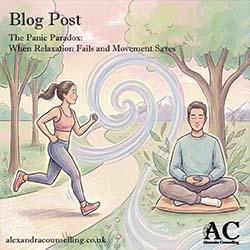 When we experience a panic attack or live with panic disorder, it is a terrifying experience. We face a range of physical symptoms—such as a rapid heartbeat, dizziness, chest pain, hot flushes, or shortness of breath—alongside distressing thoughts that something catastrophic is about to happen, or even fears that we may die or collapse. A panic attack is essentially a false alarm; it is your body’s sophisticated survival system activating the "fight or flight" response at a time when there is no actual danger to fight or flee from.
What happens when we have a panic attack?
Think of a panic attack as your body’s survival instincts overreacting. It’s essentially the "fight or flight" response—an evolutionary feature designed to keep us alive—kicking into high gear. During an episode, the body quickly gathers its resources: your heart and lungs work faster, adrenaline floods the system, and your muscles tense in preparation for a challenge.
The difficulty starts when this response triggers without a clear cause. People experiencing panic disorder often feel threatened by the intensity of the physical symptoms, which only serves to ramp up the anxiety further. It becomes a vicious cycle where the body's reaction causes fear, and that fear fuels even more intense reactions. Because of this, a major step in treatment involves learning to perceive and handle these physical feelings in a new way.
Panic attack or panic disorder?
There is a distinct difference between experiencing a panic attack and living with panic disorder. An isolated attack—marked by a sudden surge of intense fear—is a common human experience and is not a mental health condition in itself. Panic disorder, however, involves a cycle of recurrent, unpredictable attacks paired with a lasting dread of the next occurrence. This "fear of fear" often leads to significant changes in behaviour and daily routines1.
The smoke alarm analogy
Imagine your body’s "fight or flight" response is like a smoke alarm installed in a house. Its only job is to detect fire and scream loudly enough to get you to safety. A smoke alarm is designed to be hypersensitive; it is better for it to go off accidentally because of burnt toast than to stay silent during an actual fire. Similarly, it is better to run for your life when a lion is chasing you. A panic attack is like that alarm going off because of steam from a shower or burnt toast. There is no fire (no real danger), but the alarm doesn’t know that—it just does its job by making a massive amount of noise. The "noise" of the alarm—the racing heart, sweating, and shortness of breath—is terrifying, but the alarm itself isn't what is dangerous. It is simply a false alarm.
The role of relaxation techniques
You can use several relaxation tools, like rhythmic breathing (such as the 4-7-8 or box methods) and progressive muscle relaxation, to help quiet your nervous system. These techniques work by releasing physical tightness and reducing blood pressure, which helps flush out stress chemicals like adrenaline and cortisol. By focusing on your breath, you gain better control over your body and a clearer awareness of its internal signals.
The great thing about these techniques is how easy they are to use—you can practice breathwork anywhere. That said, relaxation can sometimes backfire and actually increase anxiety. People who struggle with panic often monitor their bodies very closely; consequently, the quietness of relaxation can make things like a noticeable heartbeat feel more intense. This extra focus can lead to more anxiety rather than less.
The impact of physical movement
During exercise, the body naturally undergoes the same physical reactions—such as a racing heart, rapid breathing, or sweating—that appear during a panic attack. The difference, however, is that during a workout, these sensations occur in a controlled and safe environment.
This can help an individual gain new experiences regarding their body: they experience firsthand that these symptoms are not actually dangerous and can even be useful. From a psychological perspective, this process is vital. Physical exercise can reduce what is known as "interoceptive fear"—the anxiety specifically linked to internal bodily sensations2.
The study by Muotri et al. emphasizes that exercise acts as a natural form of interoceptive exposure3. By intentionally raising the heart rate and breathing through sprints, patients learn in real-time that these sensations are safe. While focusing on the breath during relaxation can sometimes trigger "monitoring anxiety," exercise provides a clear, external reason for the racing heart. This makes it easier for the brain to categorize the sensation as "normal." Exercise doesn't just mask the symptoms; it retrains the nervous system so that the "smoke alarm" is less likely to go off for no reason in the future.
Other management strategies
Panic disorder is typically treated with talking therapies such as psychotherapy or counselling. Usually, the first recommendation is Cognitive Behavioural Therapy (CBT) and, in some cases, antidepressants prescribed by a GP. Through CBT, individuals learn to re-evaluate and change their mental and physical reactions to panic symptoms. This approach targets the specific thoughts and behaviours that often prolong an attack.
A key pillar of this approach is exposure therapy. Instead of running away from the triggers, you learn to face them in a safe, controlled way. As mentioned, interoceptive exposure focuses on the physical side of panic. It involves leaning into the bodily sensations you dread until your brain realizes they aren’t actually dangerous.
Making a choice
With panic disorder, there is no single "perfect" way to manage. You might need to experiment with different strategies to find what works for you. A combination of exercise and relaxation techniques can be a powerful way to move forward.
You don’t have to be perfect to start, especially if you don’t currently exercise or practice relaxation regularly. You can start with small steps: perhaps daily breathwork in the morning or a ten-minute walk if that feels manageable. It is about learning about ourselves, managing the anxiety, and recognizing that the feeling will pass—and that you can handle it.
References
(1) National Institute of Mental Health. Panic disorder: when fear overwhelms [Internet]. Bethesda (MD): NIMH; 2022 [cited 2026 Apr 22]. (NIH Publication No. 22-MH-8077). Available from: https://www.nimh.nih.gov/health/publications/panic-disorder-when-fear-overwhelms
(2) Dijkrsta, M. Brief, intensive exercise helps patients with panic disorder more than standard care. Frontiers Science News.[internet] 2026 Feb 9. [cited 2026 Apr 22]. available at: https://www.frontiersin.org/news/2026/02/09/frontiers-psychiatry-panic-disorder-randomized-clinical-trial-cbt-brief-intensive-intermittent-exercise
(3) Muotri RW, et al. Brief intermittent intense exercise as interoceptive exposure for panic disorder: a randomized controlled clinical trial. Frontiers in Psychiatry. [internet] 2026. [cited 2026 Apr 22]. Available from: https://doi.org/10.3389/fpsyt.2025.1739639
Journaling for mental clarity: How to start (and stay consistent)
15/04/2026
 You may have kept a diary in your childhood at some point, or perhaps as a teenager,
and found it helpful at the time. I certainly did, even though that childlike writing
about how school went has little to do with my current journaling practices in adulthood.
For many people, myself included, journaling comes and goes. We start it, it feels helpful,
and then we forget it; something comes up, or it becomes a chore and we don’t want to do it again.
However, there are several studies regarding the beneficial impact it can have on our mental health,
so let’s explore it further.
You may have kept a diary in your childhood at some point, or perhaps as a teenager,
and found it helpful at the time. I certainly did, even though that childlike writing
about how school went has little to do with my current journaling practices in adulthood.
For many people, myself included, journaling comes and goes. We start it, it feels helpful,
and then we forget it; something comes up, or it becomes a chore and we don’t want to do it again.
However, there are several studies regarding the beneficial impact it can have on our mental health,
so let’s explore it further.
The advantages of journaling
Help with stress, anxiety, and depression
A number of studies have shown that many people experience improvements following "expressive writing." It has been linked to the reduction of symptoms related to stress, anxiety, and depression. Research shows that people are remarkably willing to share their most painful experiences—such as grief, abuse, and failure—when given the chance. Although the act of writing is often emotionally taxing and can lead to tears, the vast majority of individuals find the process to be an incredibly valuable and meaningful exercise1, 2.
Improvements to mental wellbeing
According to a 2016 study, web-based "positive affect" journaling reduces distress and depressive symptoms while increasing overall well-being. Within just one month, practitioners saw a drop in anxiety, and by the second month, participants showed a measurable increase in their ability to bounce back from stress3. Moreover, other studies show a beneficial impact on general wellbeing, problem-solving skills, and the identification of triggers4.
In general, journaling is useful for identifying problems, barriers, and negative thought patterns5. It supports feelings of gratitude and mindfulness and can be used as a "brain dump" to release what you have been holding onto all day6, 7.
Ways of journaling
You don’t need much to start. I recommend the traditional way—using a paper notebook and pen—as the physical act of writing can be very grounding. You may feel that using your phone is easier, and that is ultimately up to you, but it can be refreshing to take a break from digital screens. Studies suggest that handwriting serves as a vital tool for both mental clarity and emotional resilience8. For those who dislike the traditional format, there are other options, including using apps, specific guided journals with prompts, or even using images and photos. Whatever works for you is the right way.
Set a goal and have a plan—be realistic
Do what works for you. There is no right or wrong way to do it; you can try journaling once a day or once a week—the key point is consistency. Decide when you will journal, whether it is a morning activity to start your day or an evening reflection. Try setting a time limit of ten to fifteen minutes. This helps it become a routine of "me time" and self-care, rather than another task on your to-do list. It is about you, your mood, your challenges, and your rewards.
Find your format
Some people enjoy "free writing," where you simply write down whatever is on your mind. Others prefer structure, and journal prompts can be very helpful. Questions should relate to your current experience. You can try prompts like:
• "How did my day go?"
• "What challenged me today?"
• "What did I learn?"
• "What am I grateful for?"
Write about challenges too
Do challenge yourself to step out of your comfort zone when it feels safe to do so. If something feels uncomfortable, you can reflect on why it feels that way. Writing enables you to face feelings on paper in a safe environment. This process can help you make sense of a situation and can often stop the problem from holding "control" over you.
Focus on the positive
Positive affect journaling involves specific prompts, such as "What are you thankful for?" It can be helpful to list three positive things from each day. For instance: what went well, what you enjoyed, or what made you smile. When you look back after a week, you will see your highlights. This gives you an account of how many positive things happen regularly, regardless of how small they are. It also helps you identify patterns—perhaps showing you that you need more of a certain activity, or less of another.
Final thoughts
If you are thinking about trying journaling, give it a go and try to build it into your routine. Remember, there is no right or wrong way of doing it, as long as you get something out of the activity and it doesn't feel like a chore.
For additional journal ideas for daily, weekly or monthly, explore this website: https://prosper.liverpool.ac.uk/postdoc-resources/reflect/journaling-to-increase-self-awareness/
References
(1) Pennebaker JW. Writing about emotional experiences as a therapeutic process. Psychological Science. 1997;8(3):162-166.
(2) Krieger, K., Altenstein, D., Baettig, I., Doerig, N., & Holtforth, M. G. (2018). Self-disclosure and expressive writing in adults: Effects on stress, affect, and symptoms. Journal of Clinical Psychology, 74(6), 891-903.
(3.) Smyth, JM. Online Positive Affect Journaling in the Improvement of Mental Distress and Well-Being in General Medical Patients With Elevated Anxiety Symptoms: A Preliminary Randomized Controlled Trial. JMIR Mental Health. 2018;5(4):e11290.
(4) University of Liverpool. Journaling to increase your self-awareness. [Internet]. Liverpool: Prosper; [cited 2026 Apr 8]. Available from: https://prosper.liverpool.ac.uk/postdoc-resources/reflect/journaling-to-increase-self-awareness/
(5) Freedom Health Insurance. I Journaled Every Day for a Month - Here is what I learned. [Internet]. Poole: Freedom Health Insurance; 2023 [cited 2026 Apr 8]. Available from: https://www.freedomhealthinsurance.co.uk/blog/personal-experience-journaling
(6.) BBC Bitesize. How journaling can help your mental health [Internet]. London: BBC; 2021 [cited 2026 Apr 8]. Available from: https://www.bbc.co.uk/bitesize/articles/zw3246f
(7.) Singh K. The neuroscience of journaling and its benefits [Internet]. Medium: Clear Yo Mind; 2022 [cited 2026 Apr 8]. Available from: https://medium.com/clear-yo-mind/the-neuroscience-of-journaling-and-its-benefits-a91218773159
(8) Rutledge PB. Why Writing by Hand Is Better for Your Brain. [Internet]. Psychology Today: Positively Media; 2024 [cited 2026 Apr 8]. Available from: https://www.psychologytoday.com/gb/blog/positively-media/202403/writing-by-hand-can-boost-brain-connectivity
Taming the Myth: Your Self-Care, Your Rules
24/02/2026
 We’ve all been there: your calendar is full, your 'social battery' is low, and the thought of adding one more thing to your to-do list—even something 'relaxing'—feels like a chore. If self-care feels like another item on your checklist, something needs to change.
What is self-care?
A massive industry has been built around the idea of self-care. You’ve likely seen images of "wellness weekends" involving expensive champagne, mountaintop meditations, or other luxuries that feel out of reach.
At its core, self-care is simply about looking after ourselves. It sounds simple, but we often make it complicated. Basic self-care is about meeting our physical needs, such as regular meals, hydration, and good sleep hygiene. It also includes essential medical care—taking medication, getting check-ups, or seeing a doctor—as well as movement, whether that’s formal exercise or just staying active.
Self-care, done differently
We can categorize self-care into emotional, spiritual, and physical activities. I could provide a massive list here because, technically, anything can be self-care. However, it must be specific to you. What works for your best friend may not work for you.
Remember: If an activity feels like a chore or doesn't feel right, it’s not self-care.
Common examples of emotional and spiritual self-care include meditation, journaling, connecting with others, practicing gratitude, or spending time alone or being in nature. Other familiar activities might include walking, yoga, reading, having a bath, or even just watching a series. The list is endless.
How to find what you need
Start by asking yourself: What do I need right now? Which of my needs are currently unmet?
Perhaps you feel like you don’t have even five minutes to yourself. Maybe you’re always rushing and eating on the go, barely remembering what you ate. Or perhaps your body feels tired and drained of energy. Your body and mind will "tell you" when something is missing; you just need a moment to identify what it is.
Of course, this is difficult. Life is busy with work, family, and deadlines. If self-care falls by the wayside occasionally, that’s okay—as long as you can find your way back to yourself. But if you are constantly struggling and your needs are never met, it’s a sign that something needs to change.
The bottom line
Self-care is about prioritizing yourself over work and the endless demands of life. This can bring up mixed emotions, like guilt. However, you can’t pour from an empty cup. To do a good job, be there for others, and—most importantly—enjoy life to the fullest, you must take care of yourself. We are all just doing our best.
Beyond the red hearts: Navigating the pressure and loneliness of Valentine’s Day
09/02/2026
 As we approach Valentine’s Day, it’s common to feel a sense of isolation. Almost immediately after the Christmas period ends, shops are filled with romantic gifts, themed plush toys, chocolates, and cards. Then, on the 14th of February, social media is flooded with posts from "happy couples"—or at least, that is how it appears. This can feel incredibly pressurizing and lonely, whether you are single or in a relationship.
As we approach Valentine’s Day, it’s common to feel a sense of isolation. Almost immediately after the Christmas period ends, shops are filled with romantic gifts, themed plush toys, chocolates, and cards. Then, on the 14th of February, social media is flooded with posts from "happy couples"—or at least, that is how it appears. This can feel incredibly pressurizing and lonely, whether you are single or in a relationship.
On Being Alone
There are many reasons why you might be alone right now. Some people choose to be single and are perfectly content; others deeply desire a relationship that hasn't happened yet. Some are taking a much-needed break from dating, while others simply aren't interested in romance.
Whatever your situation, it is okay to be single. Valentine’s Day is a highly commercialised event where we are "expected"—largely by marketers—to spend money on gifts, dinners, or holidays. It can feel like the day is unavoidable, leading to a sense of being "left out."
To Celebrate or Not?
You don’t have to celebrate anything you don’t want to. Just because the day exists and others are participating doesn't mean you are missing out if you don't. This year, the 14th falls on a Saturday; rather than a romantic obligation, it can easily be a day that is entirely about you.
Facing the Inner Critic
Seeing others celebrate can trigger a range of emotions, often waking up the "Inner Critic." This voice might bring up feelings of jealousy, inadequacy, or the sense that you are "not enough." It often leads to a comparison trap, where we assume others are "luckier" than we are.
This can easily spiral into rumination over past mistakes or failed relationships. Instead of focusing on what is missing, try to use this time to spend quality moments with yourself. Remember: your negative thoughts and your inner critic do not define you. When those thoughts arise, try to challenge them rather than accepting them as fact.
Limit the Comparison
If social media feels triggering, intentionally step away from it for the day. You likely have activities you enjoy far more than "doomscrolling." It’s also helpful to acknowledge that perfection is an illusion. We see happy photos, but everyone has their own "baggage" and struggles. A photo is a highlight reel, not a full representation of a relationship.
Reframe the Day
Make the day about something else. Focus on activities you enjoy—hobbies, a trip to the gym, watching your favourite series, cooking a nice meal, or going for a walk. Whether you spend it with family, friends, or in your own company, you get to pick and choose what feels good.
Treat yourself with the same kindness and care you would offer a loved one. By choosing a healthy, alternative focus, you can turn the day into one of gratitude, rest, and genuine self-care.
Blue Monday: The myth vs. the reality
20/01/2026
 Blue Monday fell on January 19th this year. Originally created as a PR technique to sell holidays, it targets the period after Christmas when people are "recovering" from the festive season, the weather is cold, and the days are short and dark1. While it has been termed "the most depressing day of the year"2, there is no scientific evidence to back this up. Simply put, Blue Monday is a myth that can often be more unhelpful than illuminating.
Story behind the myths
The UK travel agency, Sky Travel, used a formula—which Dr. Arnall developed for their PR campaign in 2005—to promote and sell holidays during the winter months. He factored in variables like debt, broken New Year’s resolutions, and weather conditions to suggest that late January is when reality truly kicks in3. While Dr. Arnall’s original press release specifically picked January 24th, 2005, the "myth" has since shifted to become a yearly fixture on the third Monday of January.
Seasonal Affective Disorder (SAD) and low mood
In recent years, charities have used the "Blue Monday" name to raise awareness for mental health. However, the concept remains controversial. Depression and low mood do not choose specific days of the year. Many people suffer from Seasonal Affective Disorder (SAD)—often called "winter depression"—where symptoms appear and disappear as the seasons change. These symptoms usually improve as the days get longer and we receive more natural light.
Mental health matters every day
Regardless of the date on the calendar, we must look after our mental wellbeing year-round. While Blue Monday is a marketing invention, it can serve as a reminder to check in on ourselves. Winter is a season where nature slows down, and we may need to follow that pattern too. Instead of fighting the winter gloom, try to lean into the slower pace. Focus on small wins: a short walk in daylight, staying hydrated, and being kind to yourself if your energy levels are not at their peak.
Building resilience against the winter blues
While Blue Monday may be a marketing myth, the "winter blues", SAD and depression are very real experiences that require a proactive approach to self-care. One of the most vital tools we have is movement; even if it is just a 15-minute stretch at home, a gentle yoga session, or a brief walk, physical activity releases the hormones our brains need to regulate mood during the darker months. The other important thing is time spent outdoors—embracing the elements for a brief walk at the beach or a local park—as fresh air boosts wellbeing regardless of the sunshine. To navigate these months successfully, focus on mastering the basics: maintaining a gentle routine, staying hydrated, and prioritizing sleep hygiene. Remember, motivation often arrives during the activity rather than before it, so taking that first small, personalized step is the most important part of the journey4.
Your mental health is a priority every single day of the year. If you found this helpful, feel free to explore my previous blog posts on similar topics.
References
1. Mental Health Foundation. What does Blue Monday mean for our mental health? [Internet]. 2026 Jan 19 [cited 2026 Jan 20]. Available from: https://www.mentalhealth.org.uk/explore-mental-health/blogs/what-does-blue-monday-mean-our-mental-health
2.BBC News. Blue Monday: Why it’s a 'load of rubbish' [Internet]. 2020 Jan 20 [cited 2026 Jan 20]. Available from: https://www.bbc.co.uk/news/articles/c24gzm9em5go
3. Carlile J. Jan. 24 called worst day of the year [Internet]. 2005 Jan 21 [cited 2026 Jan 20]. Available from: https://www.nbcnews.com/id/wbna6847012
4. Kiss A. Winter Wellbeing - A counsellor's guide to winter wellness, SAD, and mood changes [Internet]. 2026 Jan 6 [cited 2026 Jan 20]. Available from: https://alexandracounselling.co.uk/blog.html
Stress - our not-so-hidden “killer”
13/01/2026
 Everybody knows stress; the majority of people experience it every day, and it is a common thread throughout our lifetimes. Originally, stress served a positive purpose. For instance, a new experience, a challenge, hitting a deadline, or a competition are all situations where stress acts as a motivator. However, the real issue lies in how we cope with distress and how long that stress lasts. Chronic stress is an entirely different level where the response is no longer healthy or helpful.
Types of stress
Experts categorize stress into different types, depending on whether it is a short-term jolt or a long-term weight, and what specifically is triggering that response1. While there are other types of stress, this article focuses on the three most common experiences:
- Acute stress: is the body's immediate reaction to a sudden challenge. It triggers a temporary "fight-or-flight" response, characterized by a rapid heartbeat and a surge of adrenaline.
- Chronic stress: arises when a stressor remains unresolved over time. This persistent strain can cause cumulative damage to both mind and body.
- Psychological stress: is driven by mental and emotional triggers, including perceived threats and persistent worries.
The factors of stress
Stressors can be categorized into external circumstances and internal psychological factors2
External stress factors (including biological and social):
- Financial problems
- Relationships and family
- Education
- Work
- Major changes and transitions
- Pressure and responsibilities
- Environment
- Housing
- Physical health
- Gender and age
- Genetic vulnerabilities
- Neurochemistry
Internal/Psychological stress factors:
- Behaviour
- Personality
- Attitudes/self-belief
- Coping mechanisms
- Resilience level
- Self-esteem
- Support network
- Learning
How we react to these depends on a lot of things, for example, our upbringing, resilience, and support systems. Stress is a deeply individual experience.
The science of the stress response
Stress is more than just a feeling; it is a total-body reaction. When we encounter a "stressor"—which can be anything from a physical threat to a psychological worry—our body works hard to maintain its internal equilibrium, a state known as homeostasis.
To do this, your brain coordinates a complex interplay between your nervous system, your hormones, and even your immune system. Your body utilizes two distinct pathways: a rapid response for immediate action and a slower, hormonal response (led by the HPA axis) to endure ongoing pressure. Understanding that stress is a biological tool for survival can help us be more compassionate with ourselves when we feel overwhelmed. It is our body’s way of trying to find its way back to a more balanced state.
Physiological & cognitive consequences
When we are stressed, our body produces hormones called adrenaline and cortisol. In an acute phase, we feel an elevated heart rate, shallow breath, palpitations, and muscle tension. This tension often leads to physical pain, such as headaches, we can also experience nausea, or an upset stomach. If stress becomes chronic, it can lead to serious health problems, including cardiovascular disease, weakened immune systems, chronic inflammation, and sleep dysregulation3, 4.
Psychological consequences
Psychologically, stress often manifests as emotional volatility. You may feel frustrated, irritable, or even experience outbursts of anger. Alternatively, it can lead to a constant state of anxiety, worry, and a sense of being "agitated" or "on edge”.
Beyond emotions, stress has a profound impact on our cognition, including brain fog, rigid thinking, memory problems, and decision fatigue.
Behavioural manifestation
The body temporarily "turns off" or reduces interest in activities that aren't necessary for surviving a crisis right now. This can result in: loss of appetite or binge eating, reduced libido, sleep disruption, self-medicating (i.e.: smoking, taking drugs, drinking alcohol), and stunted growth.
Tackling stress - what can we do and control
It often feels like we are out of control, especially during major life events like bereavement or job loss. However, focusing on what we can manage is a vital step in stress management.
Physiological interventions
This involves calming down our nervous system:
- Breathwork: slow and controlled exercises, for example, box breathing.
- Exercise: releasing tension physically to help process stress hormones.
- Prioritising basic needs such as sleep, nutrition and hydration
- Mind-Body exercise such as yoga or meditation
Psychological interventions
- Counselling or psychotherapy: working with a therapist (such as CBT or integrative therapy) to identify triggers and build functional coping mechanisms.
- Mindfulness: practising body scans and progressive muscle relaxation to stay grounded in the present.
- Social connection: engaging with your "right" people—those who offer genuine support and safety.
Stress may be a "hidden killer" when left unaddressed, but it does not have to be your permanent state of being. By recognizing the signals your body is sending you—whether that is a tight chest, a racing mind, or a loss of interest in your hobbies—you can begin to take small, manageable steps toward ‘recovery’.
Remember, the goal is not to live a life entirely free of stress, but to build a toolbox that allows you to return to balance when the storm passes. If you find that your "marathon" response has been running for too long, reaching out for professional support is not a sign of weakness, but a vital step in reclaiming your well-being.
Reference:
1. Chu, B., Marwaha, K., Sanvictores, T., Awosika, A.O., Ayers, D. (2024), ‘Physiology, Stress Reaction’, StatPearls Publishing, available [online]: https://www.ncbi.nlm.nih.gov/books/NBK541120/
2. Mind (n.d.), Causes of Stress, available [online]: https://www.mind.org.uk/information-support/types-of-mental-health-problems/stress/causes-of-stress/
3. Ghasemi, F., Beversdorf, D.Q., Herman, K.C. (2024) ‘Stress and stress responses: A narrative literature review from physiological mechanisms to intervention approaches’, Journal of Pacific Rim Psychology, 18. Available [online]: https://doi.org/10.1177/18344909241289222 (Original work published 2024)
4. Lieberman, D.E. (2021), Exercised: The Science of Physical Activity, Rest and Health, Penguin Books
Winter Wellbeing - A counsellor's guide to winter wellness, SAD, and mood changes
06/01/2026
It’s often not just about winter; many people who are sensitive to darker days, less sunshine and daylight, and colder days already feel a difference in October and November. As the winter solstice approaches, we have our shortest day of the year, when at around 4 pm we see the night approaching. I specifically noted this last January and February, that we only had a handful of days of sunshine, and the rest was about clouds, gloom with rain or without. No wonder why people feel low, miserable, and feel that summer will never return. It eventually will, but we still need to survive until spring welcomes us again.
Winter blues and SAD
SAD - Seasonal Affective Disorder “is a type of depression that comes and goes in a seasonal pattern,” according to the NHS. It is also called ‘winter depression’. Many people experience it during the shorter and colder winter months, but its severity can differ. Several people feel a bit lower and more lethargic, but can function well. I have met people who didn’t feel any difference whatsoever, but more people feel it to some degree. For people who live with SAD, it can feel really a struggle and challenging, especially the January and February times. Symptoms can include—not limited to—persistent low mood, need for more sleep, lethargic mood, irritability, and brain fog.
The reality and explanation of SAD
Although the days technically begin to lengthen after the winter solstice, the progress is often painfully slow. For many, winter becomes a cycle of 'perpetual night,' where we wake in the dark and finish our responsibilities long after the sun has vanished. This lack of daylight does more than dampen our spirits; it disrupts our internal chemistry by knocking melatonin and serotonin out of balance. This shift throws our circadian rhythm—the body’s internal clock—off course, resulting in the fatigue and low mood characteristic of SAD.
Movement: The vital start
For me, personally, movement was vital against SAD. I started more regular exercise in January and I consistently did it at least 4-5 times a week. It is, of course, dependent on our timetable, availability, capacity and so many other factors, but physical movement is essential here. It is important all the time during the year, but especially during winter. This can include a sport, physical exercise, walking, running, yoga, whatever works for you.
Ideally, 20-30 minutes a day, but again, this needs to be personalised for you. A gentle exercise is also highly beneficial, namely, yoga or stretches. You don’t have to pay for memberships and personal trainers if you don’t want to (or don’t have the money for it); exercise can be done at home whether you have equipment or complete a 15-minute stretch video online. There is an existing wealth of literature explaining why physical movement is helpful both physically and mentally, mentioning different hormone production while we’re engaging with movement. If you don’t practice anything, think about what is possible and how you can do it. Don’t immediately jump into 4-5 times a week, you can start with something smaller, have a small and personalised goal; the main thing is the start and intention.
Getting outside: embrace the elements
Try to go out and about as often as you can. Look around your location and see what’s available. A brief walk in a local park, running outside if that’s appropriate, spending time at the beach watching the waves, wandering in a wood/forest, being in your garden. It’s often the case that we don’t feel very motivated when it’s cold, windy or even rainy. We can, of course, try the days when it’s sunny and less rainy or windy, but that’s not always the case and we don’t control the weather.
Plan some time outside, even if it’s brief. Dress accordingly, have waterproof stuff, and go out. If you are normally not someone who visits lakes, forests, walking paths, and so on like myself, you can still go out and be in nature. Fresh air will be beneficial regardless of having sunshine or not.
Build a routine
If you struggle with SAD and winter blues more, have a stable routine that works. It doesn’t have to be overly complicated, rigid, or planned for 24/7. Planning the mornings can be the most important thing as this is the time many people struggle with, but evenings, especially after work time, also feel vital. It can include meal times as well as exercise, work, and anything that feels relevant.
As motivation and interest in things we normally like are often significantly reduced, we can feel that we don’t want to do something even if we know we will feel better afterwards. It’s important to do the activity, as motivation often comes during the activity and not before. We need that little push from ourselves and to take that step.
Mastering the basics: sleep, nutrition, and hydration
Basic needs and physical self-care include our nutrition, fluid intake, movement, and sleep. If our basic needs are not met, we cannot really do much more as these basics affect everything else; our quality of life, how we feel, our brain, relationships, etc.
Think about your nutrition and fluid intake; make sure you drink enough water each day even if you’re not a thirsty type like myself. Ensure you eat enough and have meals during the day. Everything we eat and drink affects our well-being. For example, drinking several coffees a day often causes anxiety and we feel too hyper even when it's no longer needed. Caffeine and alcohol influence how we sleep and the quality of it. Sleep is probably the most important physical need. Consider your sleep hygiene, what you do before sleep, and if you need any changes. Do your research on the topic if that’s needed. In some cases you might need to speak with a professional, like a GP.
Professional help
This can include help from your GP in different contexts. It might include a blood test to check if everything is okay as you feel tired all the time. It might mean you need to take certain vitamins or a multivitamin or make some changes in your lifestyle. A GP can be helpful if you need a referral to a specialist, or need help with sleep or mood, or you might consider an antidepressant in some cases. Professional help also involves seeking talking therapy, seeing a counsellor or psychotherapist, whether privately or through the NHS.
The main thing is to get your control back and do something for your well-being—something that feels important and relevant. Longer days and sun will come along the way.
Reference:
NHS (2025), Seasonal Affective Disorder (SAD), available at: https://www.nhs.uk/mental-health/conditions/seasonal-affective-disorder-sad/
Accessed: December 2025
Wintering - Navigating the new year
03/01/2026
After the bright festivities of December, many find January feels exceptionally long. With its dark days, lack of sunshine, and cold temperatures, we often label this month as "miserable" or "unwanted." For those sensitive to Seasonal Affective Disorder (SAD) or the winter season in general, January can be a particular struggle. But how can we shift our perspective?
Wintering - The art of slowing down
Look at what happens in nature during the winter months: everything slows down. Leaves have fallen, trees are bare, and the world feels quiet and motionless. There is no rush. Winter possesses a unique stillness that holds its own beauty.
In modern life, we are conditioned to always be "on"—engaged, rushed, and tethered to an endless to-do list. However, many of us lack the same energy levels in winter as we do in summer. This is a natural signal that we need to slow down. There is nothing wrong with needing more sleep or more solitude. This season can be about finding inner peace rather than trying to "fill" the quiet. Instead of the pressure of "New Year, New Me," we can give ourselves permission to step back
Identifying the changes you need
Instead of rushing to meet unrealistic resolutions, ask yourself: What do I actually need? Start with the basics: Are your physical needs being met? Consider your sleep hygiene, hydration, exercise, and nutrition. If these are lacking, what small steps could you take? Beyond the physical, consider your social needs, self-development, or work. If you recognize a need for change, remember that it doesn't have to happen overnight. Change is a gradual process; the first step is simply defining what you need and why.
Sensory support for the brain
Engaging your senses can significantly improve your mood. Physical warmth is scientifically linked to wellbeing. You might explore temperature play through saunas, alternating hot and cold water in the shower, or even sea swimming (for the brave!). At home, a weighted blanket can provide a similar sense of grounded comfort.
Beyond temperature, consider auditory and visual aids. While upbeat music is great, you might also try a sound bath or nature sounds like rain, rivers, or birds. If you can, get outside to hear the birds or the rhythmic sound of waves and pebbles on the shore. Visually, while natural light is best, "atmosphere" lighting or a dedicated SAD lamp can help regulate your brain's clock during the darkest weeks.
A month for self-care
Self-care is vital year-round, but as we slow down, we have more space to turn inward. Try to let go of the guilt of not being "100% productive." Whether you have twenty minutes or an entire weekend, use that time to reconnect with yourself. This could be a hot bath, yoga, cooking a nourishing meal, or a brief walk. It isn’t about doing more; it’s about doing what restores you.
Personal Note: I find that winter is the perfect season to rediscover the joy of reading. If you’d like to explore these themes further, I highly recommend the book Wintering: The Power of Rest and Retreat in Difficult Times by Katherine May.
Coping with Anxiety as Christmas Approaches
15/12/2025
The Christmas countdown is on, and with it comes the common pressures of gift-giving, social expectations, and managing complex family dynamics. You’re not alone when you feel stressed, anxious and overwhelmed by all of it. Read on for key tips to protect your peace this December.
When December approaches, many people think about Christmas, of course. In recent years, we can see Christmas decorations and food in shops, supermarkets, and online as early as September. Even if you don’t like it or don’t celebrate Christmas, it’s everywhere; people talk about it at work or outside of it, it’s on the TV including films, series or adverts, you find adverts online, and so on. Even for people who like it, it can feel stressful and anxiety-provoking.
Managing Gift Pressure and Budgets
Probably the number one anxiety and stress-provoking activity is buying presents for family members, friends, colleagues, or participating in Secret Santa. Many people feel pressurised to buy expensive gifts for each other, and when having children around, feel the need to buy as many as possible. Buying gifts can be a way to express our love, there is no doubt. However, it’s not the only way and doesn’t mean that we have to spend a fortune on these things.
This is also important if we—and this is probably true for the majority of us—work with a budget and don’t have an unlimited amount of money. Put it simply, we can make a list of people we need to buy gifts for, we need to know our budget, and plan accordingly. In recent years, several people/families have started to have a tight budget on gifts and having a threshold limit. This can be something small and representative such as £10, or anything that you all agree with.
Mindful Consumption: Shopping with Intent
Shopping can include the food shop, getting ready and prepared for parties, family gatherings, and home, and of course, we want to feel like well-prepared hosts. Shopping can also be something we do in the heat of the moment, as the majority of shops and supermarkets have Christmas departments or related items.
If you want to spend money, you can easily do this. It’s important to consider whether you really need that extra cake, bottle of expensive alcohol, or decoration for the living room you don’t even have the room for.
Navigating Family Gatherings and dynamics
For plenty of people, seeing family or certain family members can cause stress and anxiety. Families are complicated and complex. Sometimes we only see certain people once or twice a year, and this normally includes Christmas.
If things feel heavy and we are not so much looking forward to the event, we can try to have a preparation plan before we attend the big family dinner. This can include considering our needs before we go, having an escape plan, considering our boundaries, how to communicate these, and what the consequences are if someone crosses them. For example, we might attend the event, but only stay for 3 hours, and we state this beforehand. With this, we have stayed, engaged, spent time together, not too much to become overwhelmed, and we know how to leave and why. This would represent our boundaries too.
Establishing and Defending Your Boundaries
Everybody has an opinion (or two), people comment and often judge. However, we don’t have to accept everything from everybody. An aunty comments on our weight every single time we meet. Nan says eat more, or try this or that food, and it’s difficult to say no. Family members and friends drink alcohol, but we don’t really want to but feel obligated to do so.
Boundary setting is also about believing it’s okay to say no or express our views/thoughts/feelings in a civil and polite way. It’s not the end of the world; people will still love us and can accept us. If not, that can be another topic and conversation, considering what it really means when someone cannot accept something that is important for us or to our well-being. So try to practice that; if you’re full and no longer hungry, say no thank you, say if you don’t want to drink (more), ask your aunty not to bring up the weight topic because it makes you feel uneasy, and so on.
The Magic of 'Good Enough': Ditching Perfection
Many people have an image of the perfect Christmas. It can come from childhood, when ideally we still had the magic and we can remember things as shiny, perfect, and nostalgic. In reality, nothing is perfect, and more importantly, it doesn't have to be. Aim for 'good enough,' not perfection.
It’s more important how we want to spend our time. This could mean spending time with loved ones and doing activities together, or being alone, volunteering in a community, or in that case, if you don’t celebrate it, it’s absolutely fine too. We can ask for help when it comes to household chores or shopping. Others are not mindreaders, so don’t assume people know what’s happening and what we need. Say it, tell them, ask them.
Filling Your Own Stocking: Essential Self-Care During the December Rush
08/12/2025
Are you running on low energy, constantly planning the next event, and struggling to be present amidst the holiday chaos? For many, December's relentless social demands feel overwhelming. This guide emphasizes the importance of 'preventative care,' offering practical tips to help you recharge and truly enjoy the season.
More often than not, I hear people saying how busy they are throughout December. This often includes the bank holidays as well. This busyness is sometimes nice and pleasant, if you enjoy social gatherings, parties, and the buzz. Other times, it puts extra pressure on us—pressure to attend events, accept invitations, engage with family and friends, and spend more money.
This pressure and stress can be huge, causing extra anxiety and worry, stemming from others and ourselves. This is often compounded by financial worries—whether it’s the pressure to spend more on gifts, the cost of socialising, or dealing with the existing cost-of-living crisis and unexpected expenses. Even though you normally look after yourself and your needs, perhaps self-care is more limited in December, and you can quickly run out of time and energy.
If this sounds like you, please know that your feelings are valid and you are not alone. For this reason, Christmas can feel too much even before it arrives. For many people, the bank holiday periods include nothing but extra duties and chores, even though they might have some time off from work. Activities include family visits, cooking, baking, and cleaning, as well as travelling either within or outside of the UK. Therefore, self-care is more important than ever.
Here are a few ways we can proactively protect our well-being this month.
Include Yourself in Your Diary/Calendar - Prioritzed self-care
Whether you use an app, your phone, or a traditional paper-based to-do list, make sure you put yourself into the list. We are the most important assets in our lives; if we can’t function well, nothing in our lives will function well either.
Block time for basic things such as lunch, a nice long bath, watching a film or series you like or wanted to see, exercise, or going for a walk. Anything that feels relevant for you as self-care and can help you to recharge your batteries.
Have Your Own Christmas Present
Think of yourself! It doesn’t have to be huge or expensive. It can be an 'experience', like having a cup of coffee and cake at a local café, a massage that would relax you or something physical like a book you wanted for a long time or a new candle. Something that would make you more content—a present from yourself to yourself.
Protect Your Time and Energy
Boundaries and saying no are more important than ever. We cannot do everything all the time or please everyone. Sometimes we need to say no to people, things, work, or ourselves. You cannot pour from an empty cup.
If needed, prepare your days, weeks, or weekends. A rough plan is enough to see what you can physically—and mentally—do, and what feels too much. Sometimes we cannot avoid doing the 'thing' we dread (or ‘have to’), but in that case, make sure you have some dedicated time for yourself and rest afterwards or between.
Create calm & be present
This can feel like a challenge. On a to-do list, other people and things like work can be in first, second, or even third place. But what about you? When running out of energy, or being too stressed, it feels more difficult to be present or calm, as we might constantly plan what’s next. This means we are living in the future, planning something that will happen and not fully living in the moment. This can be a loss for us; we end up not enjoying family time or being with a friend, not focusing on the film or book, but instead rushing everything and everywhere. Find your moments in activities you normally enjoy and can do. Focus on what you can control instead of what you can’t. Be present with your friends, partner, pet, or kids, and truly focus on the chat or activity. Have some quiet moments or simply allow yourself to be yourself when you do what you need or want.
A Note for Introverts
This season can be particularly challenging for introverted people. There are expectations to attend parties and meetings, whether it’s a Christmas-do or a family gathering. There is noise, light, and a constant buzz, and it can be too much at times.
I see many people fully booked with social gatherings throughout December. I see people feeling this is too much, running on low energy, not having enough sleep, or drinking too much alcohol. If you are an introvert like myself, you need more energy on your own with your own thoughts and activities, enjoying some quiet moments.
Even if it means saying no to some things, prioritising this time for yourself can be incredibly important and beneficial. This time with yourself can mean a short period of time; we don't need to think of several hours!
Remember: Self-care is not selfish; it is preventative care. By looking after yourself first, you ensure you have the emotional capacity to truly enjoy and engage with the things and people that matter most this festive season.